Art Assembled for March

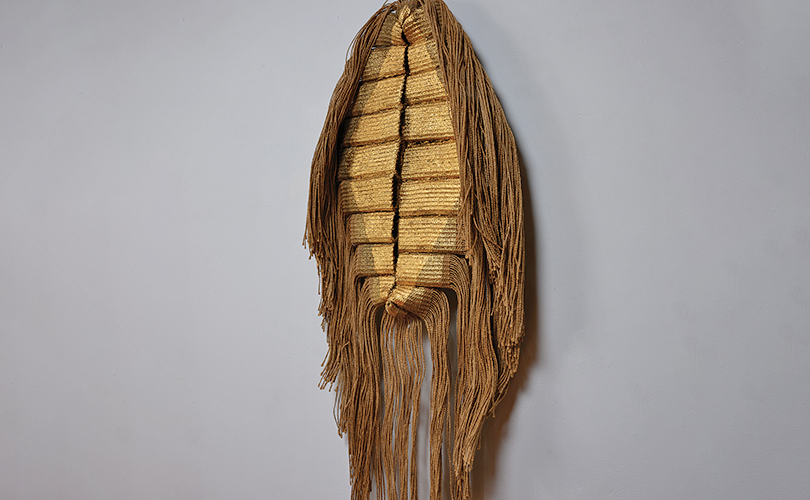
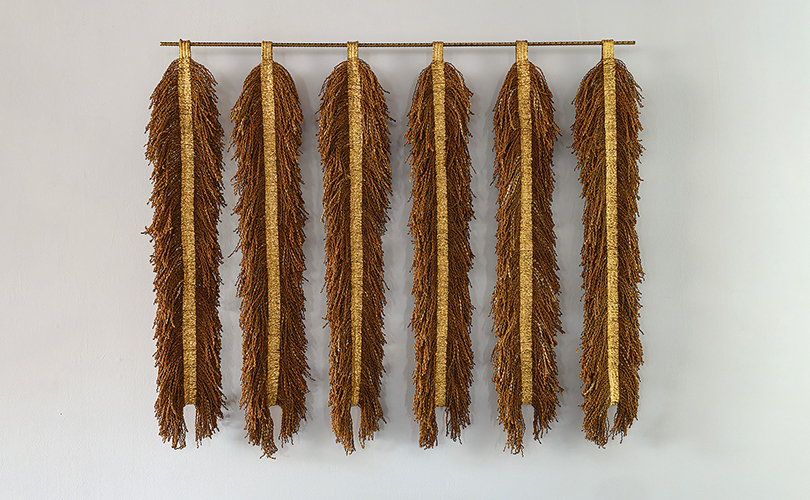
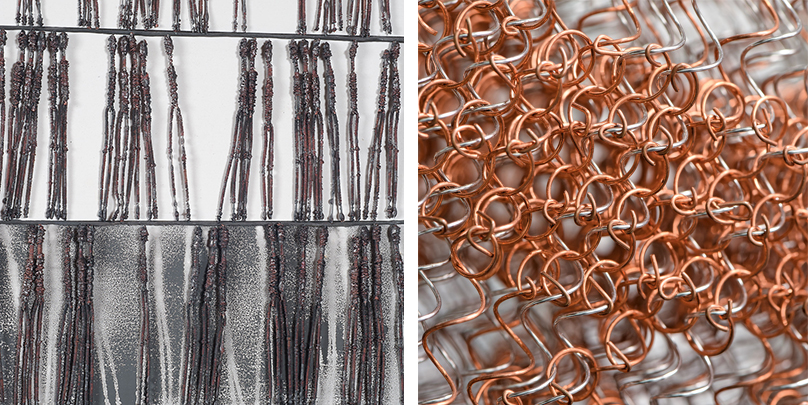
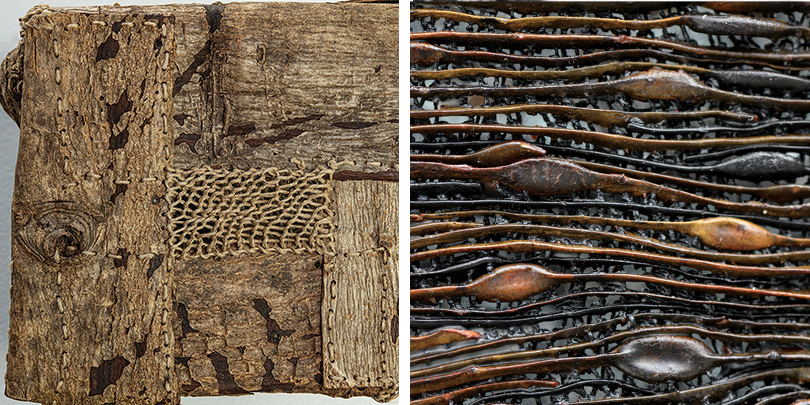
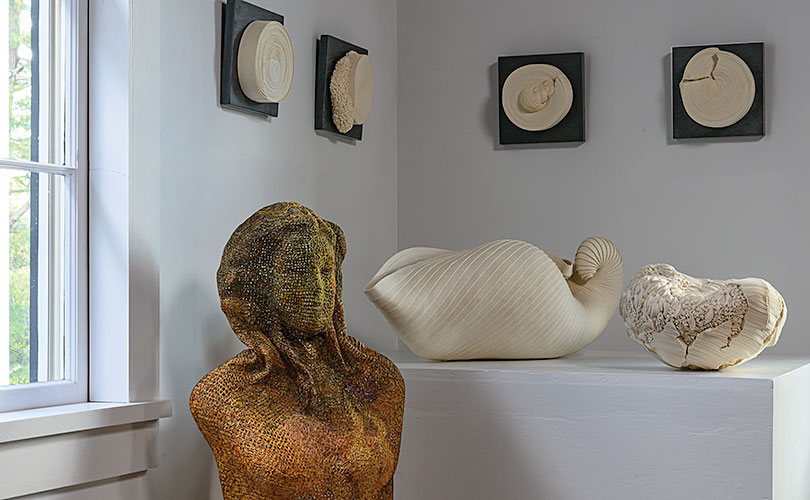
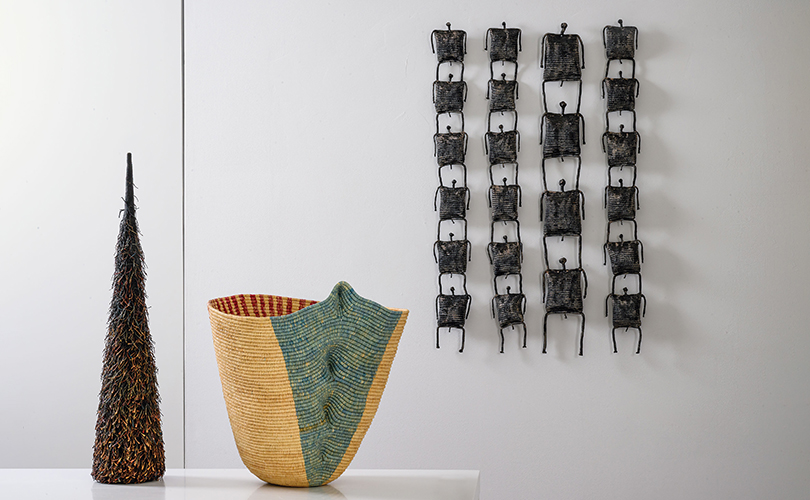
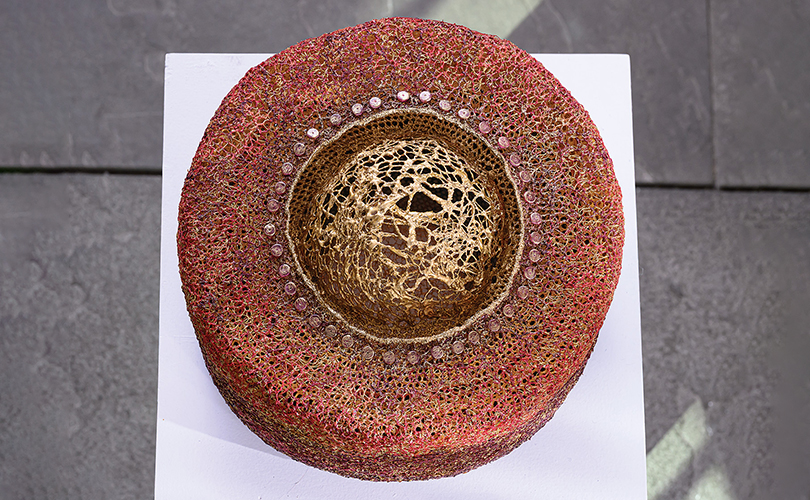
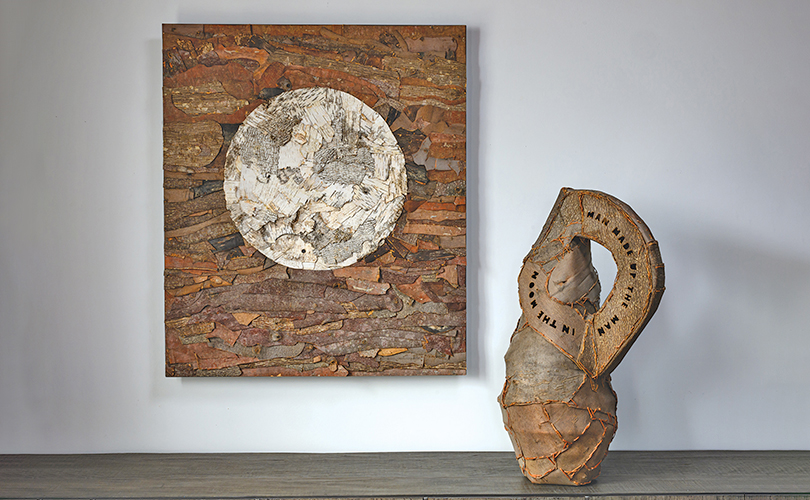
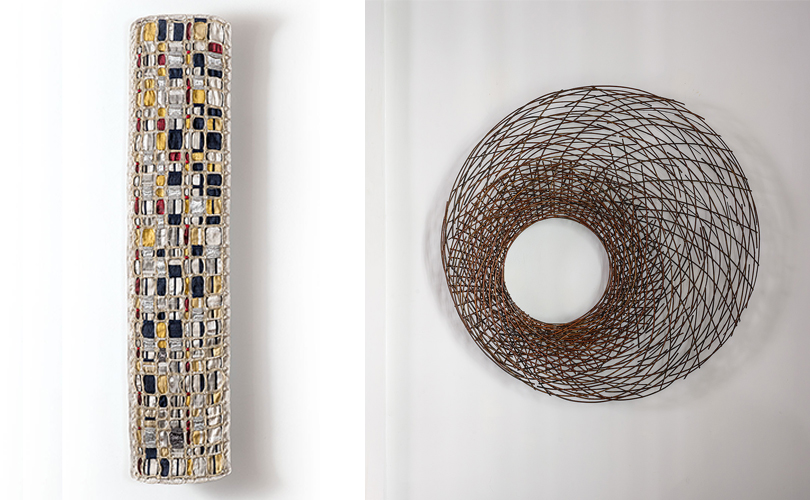
Our New this Week instagrams and browngrotta-created artlive videos in March were populated with works that evidence singular intention and mastery of a variety of materials. The featured artists reinvisioned everything from paper straws, to repurposed textiles, to willow branches with catkins intact. 

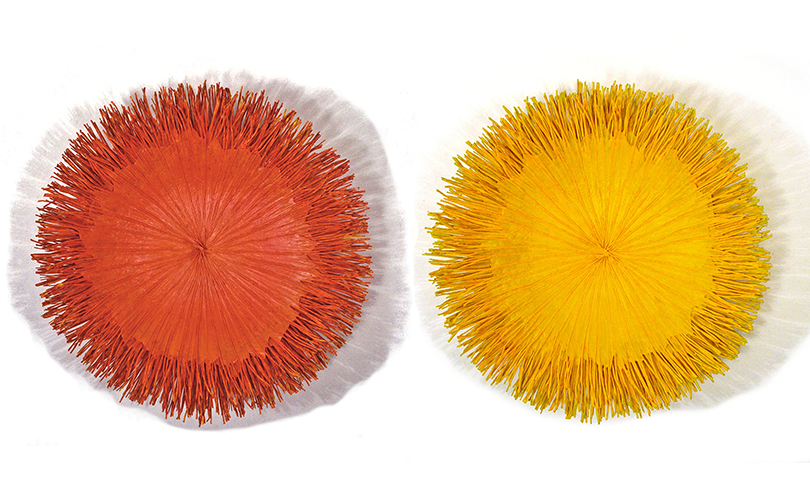
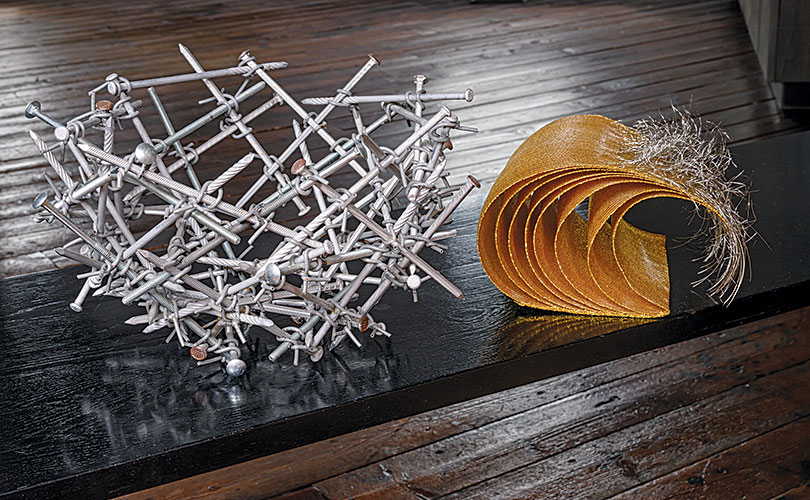
Pepsi Cola Faux Pot by Karyl Sisson
93ks Pepsi Cola Faux Pot, Karyl Sisson, vintage paper drinking straws and polymer, 5.75″ x 6″ x 6″, 2015. photo by Tom Grotta

The first work we highlighted was Karyl Sisson’s Pepsi Faux Pot. For years, Karyl Sisson has been collecting things like sewing notions — buttons and zippers, womenʼs vanity items — bobby pins, hair pins, and curlers, and paper drinking straws like the straws in Pepsi Cola Faux Pot. “I like the idea and practice of recycling and am drawn to undervalued and overlooked materials,” Sisson says. “These common, manufactured objects, reminiscent of my childhood, are the building blocks of my sculptures and wall art, while simple interlocking techniques found in basketry and needlework are usually the method of construction.”

Simone Pheulpin cotton sculpture
42sp Tom, Simone Pheulpin, cotton, 17.75” x 14.5” x 11.25”, 2023. Photo by Tom Grotta

Our video of Simone Pheulpin’s Nova, part of the Eclipse series, gives viewers an opportunity to see up close the remarkable alchemy involved in this artist’s work. In Pheulpin’s hands humble strips of cotton become remarkable objects that evoke natural phenomena. She uses a method of her own devising, using neither glue or stitches. “I’m very, very interested in the roots, the layers, everything that is natural,” Pheulpin says. “The concretions, the accumulations, I love that, that’s the basic nature, the basis of my inspiration. I really like everything that is linear, everything that is repeated, piles of wood, walls. I love the walls, also by the sea, for example, the flowing water, the marks in the sand, the desert, the dunes, all that.” Pheulpin’s work will be part of a deep dive into materials in our upcoming exhibition, Transformations: dialogues in art and materials (May 9 – 17, 2026). 

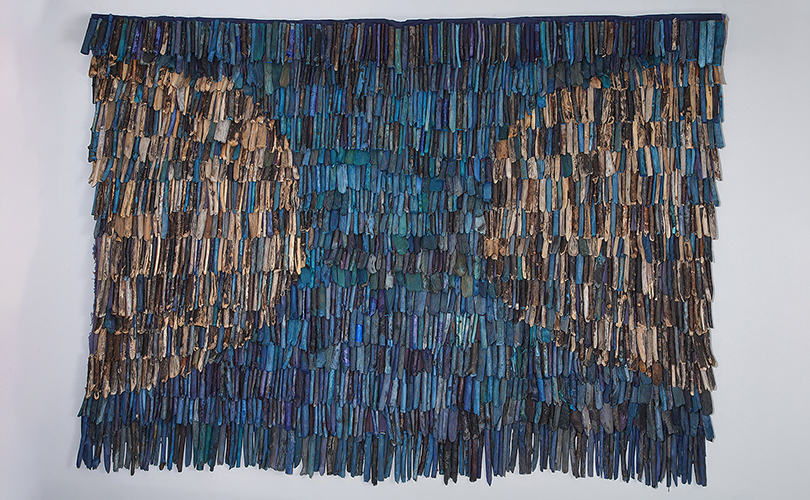
Aby Mackie textile
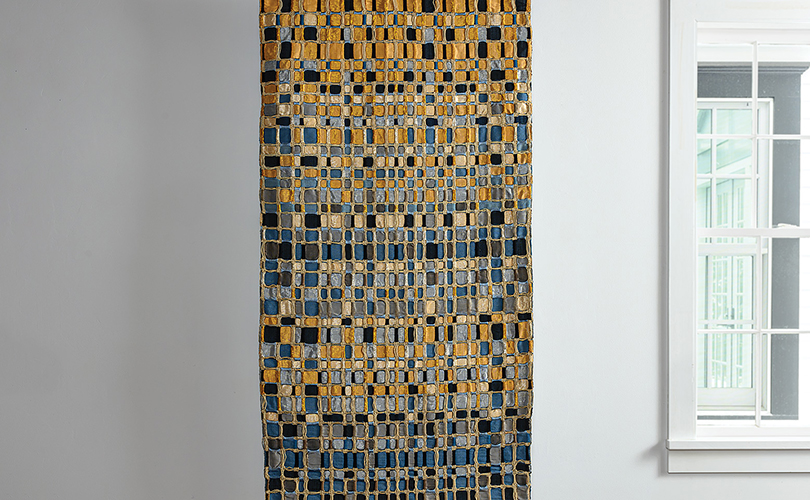
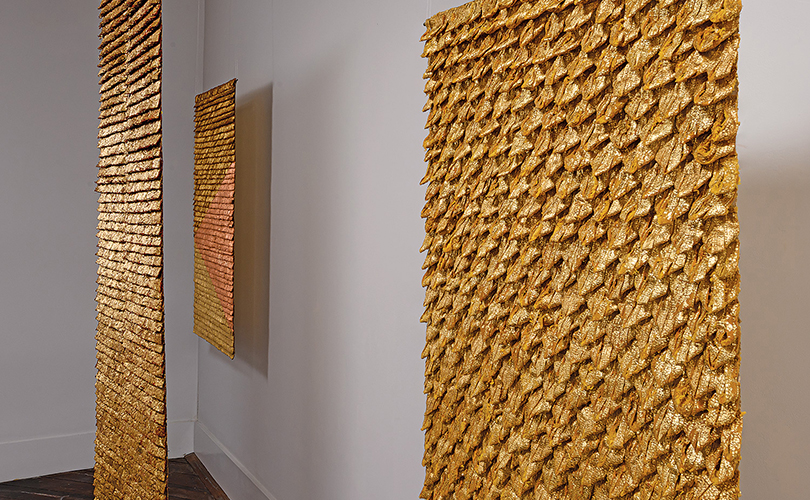
10am Between Order and Chaos, Aby Mackie, reconstructed domestic textiles 6, 83″ x 37″ x 6″, 2022. Photo by Tom Grotta

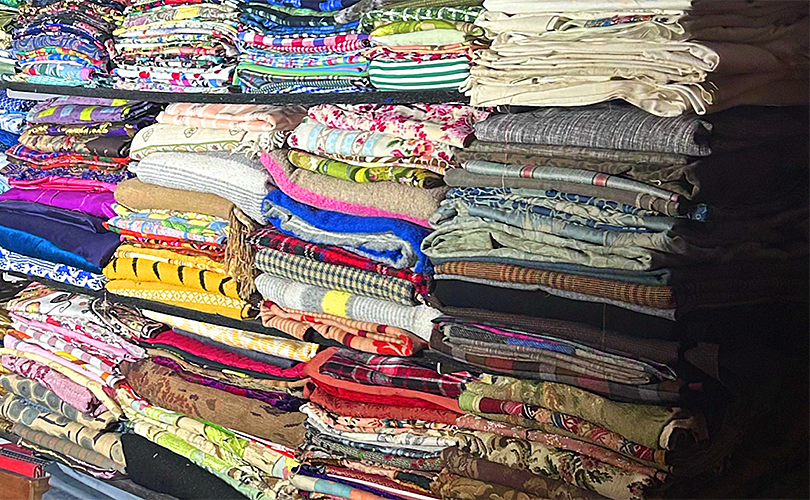
Barcelona-based artist Aby Mackie also approaches “humble” material in innovative ways — in her case, discarded textiles and household remnants are repurposed as fine art. Sourced from the streets of Barcelona, in works like Between Order and Chaos, she reimagines overlooked materials as powerful reflections on memory and value. In Barcelona, the contents of entire homes are often either thrown into the streets or auctioned off at Encants Vells market. The creation of Mackie’s work is driven by the selection and repurposing of objects and textiles from these sources in order to explore ongoing cultural themes, including materialism and consumerism. Mackie’s work will also be included in Transformations in May.

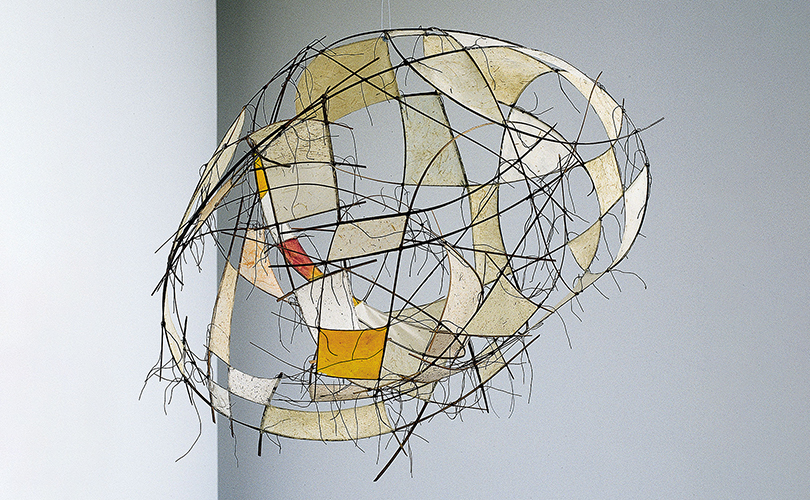
Lizzie Farey Willow basket
3lf.1 Willow Ball 2, Lizzie Farey, willow, 18” x 18” x 18”, 2000. Photo by Tom Grotta

The inspiration for Lizzie Farey’s work comes from the inherent qualities found in the natural materials around her Scotland location. Using willow, birch, heather, bog myrtle, and many other locally grown woods, her work ranges form traditional to organic sculptural forms — much of it pushing the boundaries of traditional technique.  In Willow Ball – 2 and Pussy Willow Bowl, willow seems to have been plucked unchanged from its natural surroundings, yet, with shape and color, the artist adds more. The works achieve Farey’s aim, to create baskets as reminders of the intense pleasure of nature – taking viewers to a place and a time that is universal.

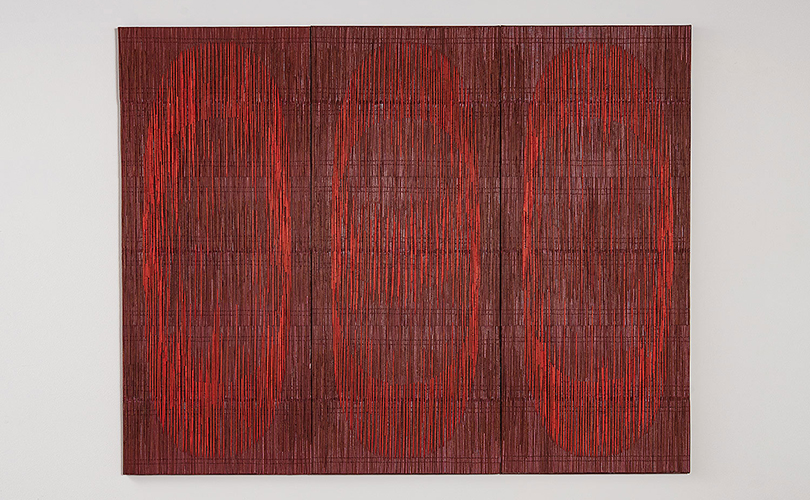
Mariette Rousseau-Vermette tapestry
600mr Verticles mdans le Bleu, Mariette Rousseau-Vermette, wool and aluminum , 38” x 38”, 1995. Photo by Tom Grotta

Mariette Rousseau-Vermette was a noted Quebec-based Canadian tapestry artist who pioneered innovations in fiber art during the 1960s, 70s and 80s. Rousseau-Vermette created weavings in which she experimented with scale, form, material, and color, which became known as tapestry-paintings. In Verticles dans le bleu the artist incorporates metal tubes wrapped in wool to create dimension and interest. Rousseau-Vermette’s work mixing optical fibers and wool will be included inTransformations in May.

John Garrett basket
38jg Charred Black 2, John Garrett, Hardware cloth scrap, paper pulp, acrylic paint, rebar tie circles, aluminum rings, black rubber lacing, plastic covered electrical wire, 6.5″ x 8″ x 8″, 2025. Photo by Tom Grotta

In Charred Black 2, part of his Seven Baskets series, John Garrett fashions welded wire mesh into a vessel shaped by conflict and renewal. Inspired by images of war-torn landscapes, layers of paint, metal leaf, and bound wire evoke structures scarred and rebuilt, holding both destruction and resilience within their forms. “I had seen many pictures of the destruction of wars in Sudan, Ukraine, Israel, and Gaza,… Piles of debris littered landscapes,” Garrett says. “My painted paper baskets looked to me like structures distressed and damaged and covered in dust.”  Forms were painted and repainted and became new again while speaking of horrors between the layers. Shiny metal leaf covered the interiors and exteriors of others. Charred Black 2 was wrapped with rings of plied wire and tied down with more wire or fabric, bringing to mind a structure awaiting more layers of concrete or plaster. 

Dorothy Gill Barneslooking glass sculpture
102dgb Spalted Maple Looking Glass, Dorothy Gill Barnes, spalted maple, glass lens, 9” x 18” x 14”, 2005-2013. Photo by Tom Grotta

In the 1970s, when she was in her 40s and early 50s, Dorothy Gill Barnes taught herself basketry through books, independent study, occasional classes, and connections with traditional makers, also drawing inspiration from contemporary artists and emerging developments in the field. Within a decade, her strikingly original works—crafted from natural materials—gained national and international recognition. Barnes delighted in revealing the ingenuity of nature, from animal-made forms to processes of growth and decay. Her work invites viewers to slow down and truly notice. In Spalted Maple Looking Glass, she has created an interactive experience: a glass lens, frames a small twig, magnifying both the object and its hollow. Through the lens, the tiny scene appears vast — refashioning something ordinary into a moment of wonder.

41mh #165r, Marion Hildebrandt, black sisal twine, brown waxed linen warp, hand twined rush, ash strip, wood rounds with leather ties, 9.5″ x 8″ x 8″, 2000. Photo by Tom Grotta

Marion Hildebrandt studied at the University of California, where she received degrees in the decorative arts and home economics. The artist lived and worked in Napa Valley, California, where she collected the plants — grasses, branches, pine needles, and bark — that she used to make her baskets. She employed the same materials that Native Americans used when they inhabited the area. Like them, Hildebrandt appreciated the natural materials that surrounded her, utilizing her artistic vision to create artistic art forms into structural objects like #r165.


Meet Merja Keskinen:  In Transformations this May

Merja Keskinen portrait
Merja Keskinen, photo by Juha Keskinen

This year’s Spring “Art in the Barn” exhibition at browngrotta arts is Transformations: dialogues in art and material. In Transformations, we’ll highlight the unique materials adopted by artists we represent, including lead, stones, feathers, seaweed, and coconut fiber. We’ll also explore the singular results achieved by different artists approaching the same material.

Linen textile installation
Linen works by Chiyoko Tanaka, Sara Brennan, Carol Shaw Sutton, Jane Sauer. Photo by Tom Grotta

One of the those materials is linen — we’ll exhibit “quivers” by Gary Trentham, figures by Mary Giles, vessels by Carol Shaw-Sutton, and wall works by Chiyoko Tanaka, Sara Brennan, and new to browngrotta audiences, Merja Keskinen.

Merja Keskinen tapestry detail
Detail: 1mkes Rhythm of Colors, Merja Keskinen, 80% linen, 20% cotton, 56″ x 62″, 2022. Photo by Tom Grotta

Merja Keskinen is a Finnish artist whose explorations of color and linen intrigued us. She is an illusionist, creating single surfaces that appear dimensional like that in Rhthym of Colors which gives the impression of a three-dimensional work. Her method provides additional surprises.”The texture and structure of the surface imitate woven fabric,” she says, “but I make the works without looms by braiding and sewing. I wind my yarn around frames of different sizes. Usually, the warp thread continues unbroken in the direction of the weft. I weave parts with a simple plait binding, threads of different colors cross each other vertically and horizontally, one over, one under.”

Gary Trentham, Merja Keskinen installation
Gary Trentham Hanging linen Baskets, 1mkes Rhythm of Colors, Merja Keskinen, 80% linen, 20% cotton, 56″ x 62″, 2022. Photo by Tom Grotta

Keskinen’s explorations of color are equally mesmerizing. “I combine colors and threads according to a preselected system. The impressions and changes created by the colors are based on mathematical considerations and systematics. In parts of the works, the thread colors change a few threads at a time according to the chosen system.”

Merja Keskinen textile
2mkes Horizontal Colors I, Merja Keskinen, linen, 30.75″ x 19″, 2024

The colors blend optically; subtle shifts and delicate changes are optimized. In Horizontal Colors 1 and 2,  the starting point for each work is three colors — blue, red and yellow, and three different shades of the colors —  nine thin linen threads each. The combinations of three colors created different shades of brown. The combinations of two colors created different shades of violet, orange and green. The works consist of all 81 different color combinations according to Keskinen’s predefined system. Rhthym of Colors consists of 184 differently colored parts.

For viewers, the experience of Keskinen’s work is multifaceted. The different colored threads can be distinguished when viewed closely, when viewed from a distance, the color is formed by the combined effect of the shades. The third element that impacts the viewer’s experience is spatial. “The delicate works made of transparent, light structures take their final shape only when hung in the space…, “ Keskinen explains. “The colors live according to the space. The same work in different spaces can appear as different color experiences. Light plays an important role in shaping the works.”

Merja Keskinen textile
3mkes Horizontal Colors II, Merja Keskinen, linen, 30.75″ x 19″, 2024. Photo by Tom Grotta

The artist, who graduated with a Master of Arts degree from the University of Art and Design (now Aalto University) in 1988, lives and works in Helsinki. Keskinen’s career initially focused on industrial textile design and expert positions on textile collections for public spaces, eventually becoming a full-time visual artist. She has held several solo exhibitions and participated in group exhibitions with her works at home and abroad. Her commissioned work for the Finnish Embassy in Paris was completed in 2012 and for the Finnish Pensions Agency in Helsinki in 2020. The Textile Artists Association TEXO awarded Keskinen with the Textile Artist of the Year award in 2019. The Arts Promotion Centre has granted Merja Keskinen a 5-year state artist professorship grant for 2022–26.

The artists in Transformation: dialogues in art and materialsincluding Merja Keskinen, all meet curator and historian Glenn Adamson’s definition of material intelligence, that is: “a deep understanding of the material world around us, an ability to read that material environment, and the know-how required to give it new form.” We hope you’ll come and see her work this May.


Celebrating Asia Week New York with Extraordinary Art from India, Japan, and Korea

Shin Young-Ok weavings
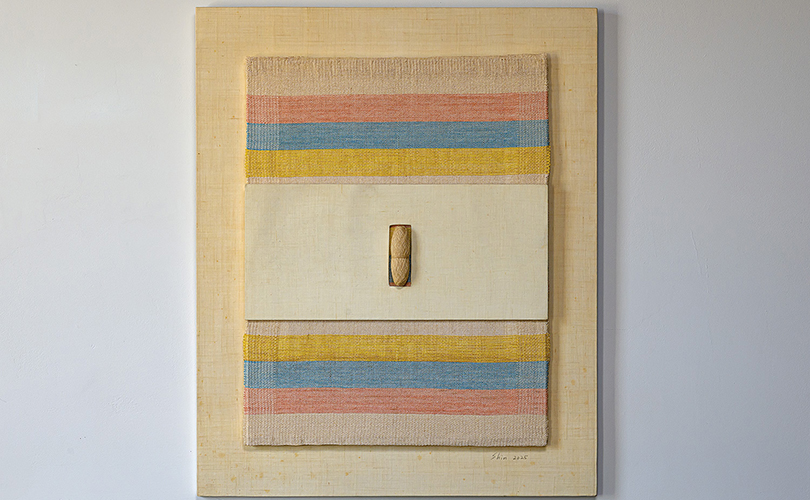
Young-Ok Shin, 6sy Lyric Space, 2014 and 7sy Harmony of Yin Yang, 2014. Photo by Tom Grotta

Each March, New York becomes a global gathering place for collectors, curators, and lovers of Asian art. Asia Week New York (March 19 – 27, 2026) brings together the world’s foremost galleries, auction houses, and museums for 10 days of exhibitions and cultural programming. Here’s a guide to museum exhibits – https://asiaweekny.com/asia-week-march-2026-museum-exhibition-guide/ – from Chinese Porcelain at the Frick, to Hindu Devotional Prints, 1860–1930 at the Met, to a solo exhibition of work by Choong Sup Lim at the Korean Cultural Center. 

At browngrotta arts, it might as well be Asia Week all year long as we have a glorious group of contemporary textile and ceramic artists from India, Japan, and Korea whose work we promote. Asia Week 2026 gives us a good excuse to highlight a select group of their works. Whether you’re a seasoned collector or simply curious, it’s a great time to explore works from these countries in depth.

Neha Puri Dhir weavings
Neha Puri Dhir, Shifting Horizons, 2023; Farmer’s Jacket, 2016; Forest Fire, 2017. Photos by Tom Grotta

First up, are stitched and resist-dyed textiles from India by Neha Puri Dhir. Her works explore negative and positive space, reflecting ideas of balance and contrast. The textured surfaces, shaped by stitches and dye migration, add a tactile depth, emphasizing the labor-intensive process she undertakes.

Kohyama, Kobayashi, Sekijima
Yasuhisa Kohyama Ceramic 11, 2001; Masakazu KobayashiBow – White, 1998; Hisako SekijimaStanding, 2001. photos by Tom Grotta
Toshio Sekiji Counterpoint 8, 2009; Jiro Yonezawa, Dance of the Sash, 2024; Chiyoko Tanaka, Grinded Fabric 4215-6 Sienna W B #215-6, 1998. photos by Tom Grotta

browngrotta arts also promotes singular ceramics, sculpture, basketry, and wall works created by more than 20 artists from Japan. Among these works are ceramics by Toshiko Takaezu and Yasahisu Kohyama. We also show vessels and sculptures by several inventive basketmakers including a group that has studied with Hisako Sekijima — Norie HatakeyamaKazue HonmaNoriko TakimayaTsuruko Tanikawa, and Masako Yoshida — as well as Shoko FukudaJiro Yonezawa, and Kosuge Kogetsu. Remarkable weavers are also represented, including Hiroyuki ShindoMasako Nakahira, Jun TomitaChiyoko Tanaka, and Naomi and Masakazu Kobayashi.

Yeonsoon ChangThe Path Which Leads to the Center III, 2022; Yong Joo Kim , No.2: 21 days, 2023; Sung Rim Park, Beyond 180623, 2023. Photos by Tom Grotta

Five Korean creators of innovative art textiles made of steel, paper, velcro, silk, and ramie are among those whose work we highlight. The effects of light and color in Jin-Sook So’s works of stainless steel reflect her years living in Korea and Sweden. Yong Joo Kim has reinvented velcro as a fabric to create evocative sculptures while Young-ok Shin explores ramie with great impact. Yeonsoon Chang transforms the “softness” of fiber, and transcends the material’s limitations with structures made of abaca fibers and Teflon-coated, glass-fiber mesh to which she attaches gold leaf. Sung Rim Park uses knots of paper, determining the shape and size of each knot based on the meanings and symbolism it holds. While the knots and fibers works that result may appear delicate, they have the power to shape space. 

Pictured here are just a sampling of the Asian artworks at browngrotta arts. Visit our website to see the entire group, by name, or filter by country: Yeonsoon Chang, Neha Puri Dhir, Shoko Fukuda, Norie Hatakeyama, Kazue Honma, Matsumi Iwasaki, Kiyomi Iwata, Yong Joo Kim, Naomi Kobayashi, Masakazu Kobayashi, Yasuhisa Kohyama, Kosuge Kogetsu, Kyoko Kumai, Maki, Nakahira, Nio, Park, Hiroyuki Sato-Pijanowski, Toshiko Sekiji, Hisako Sekijima, Kay Sekimachi, Naoko Serino, Young-ok Shin, Hiroyuki Shindo, Jin-Sook So, Toshiko Takaezu, Noriko Takamiya, Chiyoko Tanaka, Hideho Tanaka, Tsuroko Tanikawa, Jun Tomita, Mariyo Yagi, Jiro Yonezawa, Masako Yoshida. 


Artist Focus: Lilla Kulka — Where Thread Meets Shadow

Lilla Kulka Portrait
Lilla Kulka portrait by portrait by Anthony Kulka-Sobkowicz

There’s a moment in weaving — the Polish textile artist Lilla Kulka has described it — when the work surprises you. When the loom leads rather than follows. For Kulka, that surrender to process is fundamental: “In the process of weaving, I am often surprised at the direction my work takes,” she says. It’s a quietly radical statement from an artist whose career has been defined by refusing the expected.

Detail of large red tapestry by Lilla Kulka
Detail of Lila Kulka’s, Pair, sisal, wool, stilon, 125″ x 77″, 1989. Photo by Tom Grotta

Born in 1946 in Kraków, Poland, Kulka came of age in one of the great centers of European textile art — a city where the Academy of Fine Arts carries a legacy stretching back to 1818, and where fiber art was being radically reimagined in the postwar decades. She went on to become a professor at that same institution, shaping generations of Polish artists in her unique fabrics studio.

Steel weavings by Lilla Kulka
14lk Interference: (Ingerencja): LL; 15lk Interference: (Ingerencja): LK; lk Wall and Secrets: (Mur i Tajemnica): Two Worlds, Lilla Kulka, steel, linen, cotton, and fine jewelers’ silver thread, 36.5” x 32.75” each, 2007-2013. Photo by Tom Grotta

Kulka’s work defies easy categorization, which is precisely the point. She creates art on the intersection between fiber art, painting, and sculpture, and has spent her career dismantling the hierarchies that place one above another. As she puts it: “Rather than locking myself within the bounds of any one artistic tradition, I have disregarded such artificial barriers to expression.” The results are monumental. Works like Traces (1979) — woven in sisal and handspun wool, stretching nine feet tall — pulse with human presence without depicting it literally. Her early figurative vocabulary evolved into something more elusive: human shadows, outlines, traces of bodies rather than bodies themselves. These were meditations on the great mysteries of life — pain, power, love, faith — rendered in the language of horizontal and vertical lines. 

Lilla Kulka installation
16lk Tunnel Pamieci (Tunnel of Remembrance), Lilla Kulka, cotton, gauze, various threads and paper, 108″ x 40″ x 92″, 1992. Photo by Tom Grotta

What makes Kulka’s work particularly charged is its context. She has acknowledged that the political situation in Poland made it difficult to present all of her work publicly in the 1970s and early 1980s. That the work survived and circulated internationally is a testament both to her determination and to the peculiar freedom that fiber art, long dismissed as craft rather than fine art, sometimes enjoyed under censorial regimes.

Blue Lilla Kulka tapestry
7lk Odchodzacy (DEPARTURE II) , Lilla Kulka, wool, cotton & stilon, 92″ x 36″, 1993. Photo by Tom Grotta

Her materials speak their own language. Sisal, wool, cotton, steel — she juxtaposes materials with diametrically different connotations, sometimes combining industrial slabs of steel with meticulously handwoven gobelin tapestries. Softness and hardness. The handmade and the industrial. The personal and the structural. It’s a visual argument about what it means to live in a body in a political world. Kulka’s work will be included in browngrotta arts’ upcoming exhibition, Transformations: dialogues in art and material (May 9 – 17, 2026).

Small Lilla Kulka collage
10lk Small Collages I & II, Lilla Kulka, Collage I (2 figures), 1994 , Collage II (1 figure), 22.75″ x 28.5″, 1993-94. Photo by Tom Grotta

Kulka’s work spans tapestry, painting, drawing, interdisciplinary activities, and exhibition design, and she has participated in over 300 exhibitions across 17 countries in Europe, the United States, Canada, Mexico, Brazil, and Israel. She has shown at venues ranging from the Central Museum of Textiles in Łódź — home of the prestigious International Triennial of Tapestry — to galleries in Vienna, Düsseldorf, Chicago, and beyond. 

Orange tapestry by Lilla Kulka
8lk Traces, Lilla Kulka, sisal and hand spun wool, 108″ x 42″, 1979. Photo by Tom Grotta

The enduring relevance of Kulka’s vision was celebrated in 2025 in Krakow in a three-venue exhibition, Tempus Omnia Revelat (Time Reveals All). A comprehensive catalogue raisonné of the same name was published to accompany the exhibition that includes over 300 pages of illustrations and essays. Included are a lengthy interview with the artist and excerpts from a 2003 review by Professor Magdalena Abakanowicz. “Lilla Kulka works in techniques that did not exist before,” she wrote. “The blindness of convention may label them as weaving, yet they are magical, multilayered, and thought-provoking objects, appearing today with particular clarity against the backdrop of society’s dependence on mechanical techniques.”

Lilla Kulka Exhibition drawing
10lk Drawing I , Lilla Kulka, paper drawing, 11.75″ x 16.5″, Exhibition Drawings for the Chicago International New Art Forms Exposition at Navy Pier in 1989. Photo by Tom Grotta

For those encountering her work for the first time, the invitation is open. As Kulka herself says: “The abstract content of my work cannot be easily explained by the titles of each piece. I invite each viewer to search for and find an individual meaning in my work.”


Light Effects: the extra element

Light plays a key role in our experience of art. Artists create dramatic, immersive environments with light, shifting the focus from mere representation to a sensory experience Sometimes light is used to create an emotional impact — soft light for tranquility; cool light for tension; dark tones for despair.  Masters, such as Rembrandt and Caravaggio, used dramatic contrasts between light and dark to create mystery and theatrical focus. Symbolically, light has been used to represent divinity, knowledge, and revelation — often in religious contexts. In other works, light creates the illusion of depth, sculpting form and volume. In contemporary works light is the medium itself — LEDs, neon, optical fiber.

Light can also impact a viewer’s experience — influencing the narrative, highlighting focal points. In the works pictured here, light influences the viewer’s experience, creating one — or more —  works when light is shown on the art and a very different second work when shown without a light source. Straight on, light may turn a metallic-tinged work a brilliant white. When light is indirect, the highlight dim and new qualities emerge.

Adela Akers Night Pyramid tapestry
17aa Night Pyramid, Adela Akers, linen, horsehair and metal, 28” x 100”, 1999. Collection of the Metropolitan Museum of Art. Photo by Tom Grotta
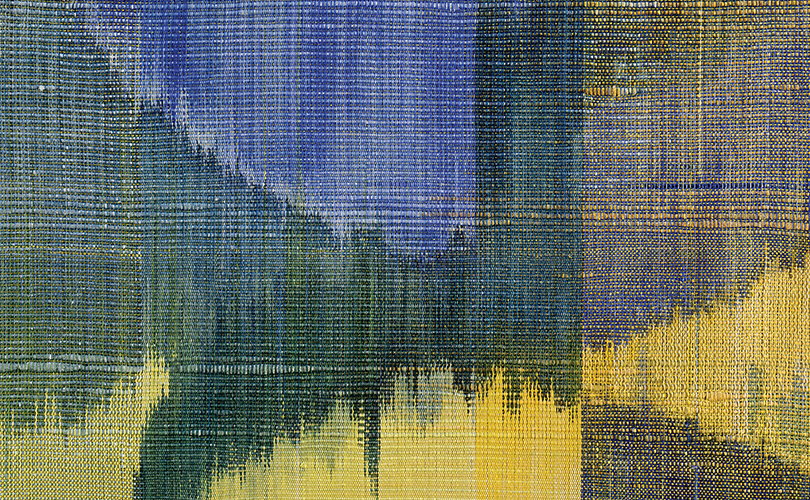
Polly Barton Serence Countenenace textile
11pd Serene Countenance, Polly Barton, Japanese silk and metallic monofilament warp with indigo pigment and soy milk; metallic thread weft woven in two panels, 47″ x 57″, 2013. Photo by Tom Grotta

In Adela Akers’s Night Pyramid, a mountainscape comes into sharp focus when illuminated. The image is formed from small strips of foil integrated into the weaving. In Serene Countenance by Polly Barton, the artist uses metallic monofilament and metallic thread to create a subtle glimmer in shadow that transforms into a glowing orb when a light source is introduced. The weft’s metallic thread is brass wrapped around a nylon core, while the warp is a striped combination of silk and metallic-coated monofilament. Other examples of works incorporating metallic threads are Baiba Osite’s Lauks (Field in Autumn) and Animal by Lija Rage.

Gold leaf Glen Kaufman
Glen Kaufman: 12gk Yoshikawa, Noto; 233gk Murgang-sa Namsan; 13gk Pulguk-sa, Kyong-Ju, silk damask, silver leaf; screenprint, impressed metal leaf, 48” x 24” x 1” (each), 1990. Photo by Tom Grotta

While living in Japan in the 1980s, Glen Kaufman developed a unique and complex technique in which light provides the finishing touch. He began by weaving a twill pattern in silk, composing collages of photographic imagery and silk-screening those images onto the cloth. He then further abstracted the imagery by applying metal leaf. “When I began using … photography, photo silk screen, metal-leaf application,” Kaufman said, “[it] was a unique use of those materials.”

22cy The Moon, The Stars, The Sun, Chang Yeonsoon , eco-soluble resin, pure gold leaf, teflon mesh, Hung square they are 34” x 34” x 7”, 2019. Video by Tom Grotta

Yeonsoon Chang also employs metallic materials, developing a method to adhere gold leaf to fibers. Her striking works blend innovative technique with references to classical Eastern philosophy. In works such as The Moon, the Stars, the Sun, light reveals shifting perspectives and diverse experiences. In one video, illumination transforms an already intriguing piece into something entirely new, bringing the metal leaf into sharp focus and casting compelling shadows through the mesh structure

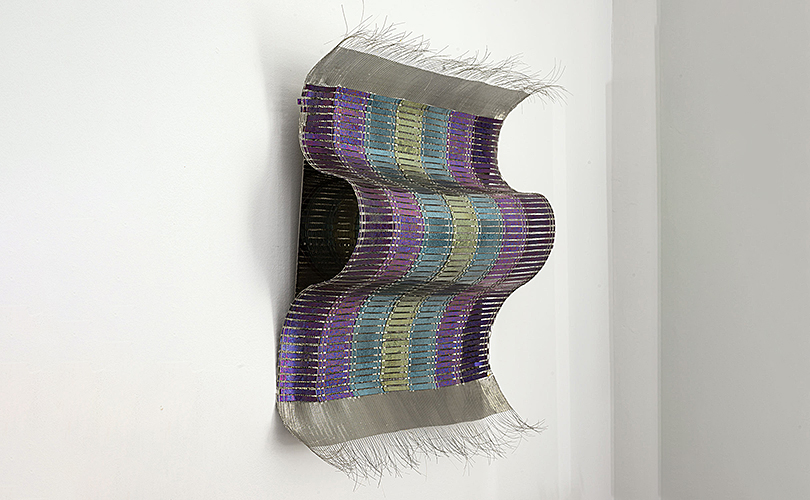
Kyoko Kumai, stainless steel sculpture
3kk Blowing in the Wind-W, Kyoko Kumai, stainless steel filaments, 2001. Photo by Tom Grotta
Mica and steel wall hanging by Agneta Hobin
9ah En Face, Agneta Hobin, mica and steel, 70” x 48”, 2007. Photo courtesy of Agneta Hobin

In Kyoko Kumai’s hands, stainless steel mesh appears infused with light, an effect heightened when an external light source is added. Agneta Hobin’s works pull glimmers of light through stainless steel mesh and the unexpected use of mica.

Fiber Optic weaving by Wlodzimierz Cygan
20wc Totems, Wlodzimierz Cygan, linen, sisal, fiber optic, 37″ x 37″ x 7″, 2022. Photo by Tom Grotta
Elégante fiber optic weaving by Mariette Rousseau-Vermette
Detail: 626mr Elégante, Mariette Rousseau-Vermette, wool, optical fiber, metallic thread, mylar, 48″ x 48″, 2000. Photo by Tom Grotta

Optical fiber provides an exciting medium for artists Wlodzimierz Cygan and Mariette Rousseau-Vermette. In Totems, a complex weaving takes on a new character when the optical fiber is lit and shifts in color. In Mariette Rousseau-Vermette’s Élégante, a slash of shimmering optical fiber creates subtle intrigue when unlit and serves as a dramatic counterpoint when illuminated. 

Several works for which light is an element or an enhancement will be included in browngrotta arts’ upcoming exhibition, Transformations: dialogues in art and materials (May 9 – 17). 


Art Assembled: New this Week in February

New this week in February was nothing if not eclectic. From Sue Lawty’s works of tiny stones to James Bassler’s reimagined yatra jacket. The works reveal diversity and intrigue.

Sue Lawty stone paintings
Sue Lawty, Coast, East Riding of Yorkshire 1-3, sea eroded stone on gesso, 12.5” x 10.5” x 1.5” each, 2024. Photos by Tom Grotta

Sue Lawty is recognized as one of Britain’s foremost contemporary textile artists. Her work encompasses weavings, constructed pieces, and drawings in both two and three dimensions, exploring rhythm, repetition, and interval. Lawty creates assemblages featuring thousands of tiny stones, like Coast, East Riding of Yorkshire 1-3, each smoothed by the sea and meticulously hand sorted, Whether making drawings and assemblages using tiny stones creating a kind of pixelated cloth, or weaving in linen, hemp, raphia, or lead, she talks of the “integrity of mark making intrinsic to particular thread or structure.” Lawtywill also be running an online workshop, Rhythm & Repetition in Woven Tapestry on Sunday, April 26  and May 3, 2026 on Zoom from 2 – 5pm GMT. To book your spot, visit the selvedge website HERE

Zofia Butrymowicz wool tapestry
Zofia Butrymowicz, Rocks, wool, 46″ x 68”, 1985. Photos by Tom Grotta

The late Polish artist, Zofia Butrymowicz emerged as one of the pioneering East European textile artists in the 1960s. Butrymowicz excelled in the wool gobelin technique, utilizing handspun wools that were often rough and irregular to create striking and textured pieces. Color was a dominant theme for Butrymowicz. She frequently emphasized color, reflecting her deep interest in experimentation and new artistic expressions. Throughout her career, Butrymowicz’s contributions to the art world were celebrated globally. Her work was included in the Museum of Modern Art’s seminal Wall Hangings exhibition. Her legacy continues to inspire.

Katherine Westphal, Bicentennial Angels
Katherine Westphal, Bicentennial Angels, embroidery, 21.25″ x 25.25″ x 1.5″, 1976. Photos by Tom Grotta

A leading figure in California’s celebrated fiber art community, Katherine Westphal was driven by boundless curiosity and creativity, exploring ceramics, quilting, fiber sculpture, photocopy collage, and wearable art with equal imagination and innovation. “Throughout her career, beginning with the batik samples she made for the commercial printed textile industry in the 1950s, [Westphal] incorporated images from her immediate world: street people in Berkeley, Japanese sculpture, Monet’s garden, Egyptian tourist groups, Chinese embroidery, images from newspaper and magazine photos, and her dogs…anything that struck her fancy wherever she happened to be at the moment – and she could put any or all of them into a repeat pattern.  Her wit and whimsy [were] legendary and her lively approach also inspired her husband [Ed Rossbach] to combine imagery onto the surface of his inventive baskets and containers,” wrote Jo Ann C. Staab in 2015 (“Fiber Art Pioneers: Pushing the Pliable Plane,” Retro/Prospective: 25+ Years of Art Textiles and Sculpture, browngrotta arts, Wilton, CT 2015.) Angels captured her interest in 1976 and resulted in the energetic embroidery Bicentennial Angels. The work is well worth a lookback in 2026, America’s semiquincentennial year.

James Bassler woven jacket
James Bassler, My Letterman Yantra, natural brown cotton, handspun silk, waxed linen – plain weave, brocade – dye immersion with off-set printing method (wicking); large figures, letters and numbers in raised embroidery, with smaller figures also embroidered in part or completely; 28.5” X 32.5”, 2012. photos by Tom Grotta

For James Bassler, the inspiration for My Letterman Yantra was an exhibition commission. He was asked by Jack Lenor Larson to create a piece in response to one in George Washington University’s Textile Museum’s collection.  Bassler reviewed the museum’s digital images, doubtful that the dotted pixels on his screen, so far removed from their three-dimensional source, would prove inspirational.  But he was drawn to an image of a garment from Myanmar (then Burma), a shirt, embellished with yantras, auspicious signs and symbols, associated with cosmic powers that will bring good things to shirt’s wearer. As he is a runner, they reminded him of the race shirts he had been given over the years for participating in marathons, covered with logos and corporate symbols.  Why not, he thought, create a 20th-century version?  The Letterman Yantra is the result, with woven fabric, and embroidered designs that include rows of running “stick figures,” the number 262 and phrases to speed the imaginary wearer and runner, on. The curator pronounced the reimagined version a great success. Larsen wrote, “The two-sided jacket of James Bassler, with ikat-like patterning, is [ ] exceptional, created with a fugitive-dyed magenta yarn wicking into the adjacent areas. If wicking prints are extremely rare, his patterning of the back side, created by clamping and steaming together the patterned front and the plain back, is a unique and primitive form of transfer printing. Bassler has been successfully sourcing museums with varied and extraordinary results for a long time, and here he seems inspired to create a technique not yet in museums!”


Process Notes: Norie Hatakeyama on Basketry Beyond the Expected

Norie Hatakeyama working on a large piece
Norie Hatakeyama at work. Photo by Ray Tanaka

In 1980, Norie Hatakeyama began studying basketmaking with Hisako Sekijima in Japan. Sekijima, who had studied basketry with Sandra Newman, John McQueen, and Ken and Kathleen Dalton in the US, was known for the innovative and nontraditional direction of her work. Hatakeyama felt “surprise and bewilderment, even joy,” when she encountered Sekijima’s methods. What most attracted her was Sekijima’s way of thinking was “that you must adopt an openminded approach to the basket.”

After a 40 prolific and successful years of art making, we’ve compiled Norie Hatakeyama’s thoughts on her basketry for this edition of Process Notes.

Norie Hatakeyama work in process. Photo by Ray Tanaka

My work involves creating three-dimensional forms using basketry techniques—taking materials in my hands and weaving them together. 

Basketry has a long history and has been practiced around the world using materials available in each region. The techniques themselves have changed very little over time. Because the entire process can be seen visually from beginning to end, it is easy to understand, and in principle anyone can make a basket. However, if one simply accepts and applies the technique without question, the result tends to be the same form regardless of who makes it, leaving seemingly little room for creation.

Norie Hatakeyama, Plaited Cube/242, Endless Line Series, Pits & Diagonal Lines
Norie Hatakeyama, Plaited Cube/242, Endless Line Series, Pits & Diagonal Lines, plaited Japanese rice paper, 7″ x 7″ x 6″; 1998, photo by Tom Grotta

Imitating technique is one form of learning and is highly effective for improving skill, but it offers limited potential for creating new forms. As an artist, in order to develop my own approach to form-making, I try not to be bound by fixed ideas. I question existing techniques themselves and re-examine them. While maintaining a calm and attentive eye toward what is happening in the process, I consider ways to resolve the questions that arise from within it. Through this reflection, I continue weaving.

Detail Norie Hatakeyam Complex Plaiting basket
Norie Hatakeyama, Complex-Plaiting-Series, paper fiber strips, plaited, 9.5″ x 18″ x 16″, 2001, photo by Tom Grotta

Eventually, as if a dam has burst, the forms begin to change, and shapes beyond my expectations emerge. These are not forms I intentionally designed; rather, they are forms generated by the material and the method. When the material changes, the form changes, too. The forms appear—they come toward me. I feel less that I ‘made’ them, and more that I was ‘made to make’ them. In this process, the artist’s own consciousness is altered, and self-transformation occurs.

Norie Hatakeyam Complex Plaiting basket
Norie Hatakeyama, Two Holes A 104, plaited paper fiber strips, 11″ x 41″, 9″, 2001. Photo by Tom Grotta

I came to realize that the forms and formative processes of many of my works—though not created as intentional imitation—closely resemble living beings found in nature (and their generative principles). That was a moment when the activity of life and my work of making forms resonated with each other.

The accumulation of small acts of ‘re-examining methods’ has brought many realizations. That became the catalyst for the emergence of my own new approach to form-making. How rich with surprise and joy the repetition of simple actions can be. My days of creation are filled with treasures of questions and wonder. All of these rest within my hands as I continue weaving, again and again.

Norie Hatakeyama, Complex Hexagonal Plaiting Spiral,
Norie Hatakeyama, Complex Hexagonal Plaiting Spiral, paper, string, plaited, 7″ x 26″ x 22″, 1994. Photo by Tom Grotta

From a mathematical point of view, my baskets turn out to polyhedra shapes abstracted in pure geometry. However, that doesn’t mean I created the form using geometrical structure. It means the form has appeared as redefined. Geometry might be incorporated into the method, but it would seem that the forms come out from another world.

In basketry, the expanse is infinite. Making baskets is not just denying the chaotic world and one’s own inconsistency; it reaffirms those things. There is no point in asking whether my work is mathematics, art, or science, because I would say that the basketry formula is the very formula itself for nature.

Norie Hatakeyama
1999 and 2026

Norie Hatakeyam Complex Plaiting basket
Norie Hatakeyama, Complex Plaiting Series – Connection I-9609, paper fiber strips, 21″ x 22″ x 19″, 1996. Photo by Tom Grotta

Norie Hatakeyama’s work Complex Plaiting Series – Connection I-9609 will be included in browngrotta arts’ up coming exhibition, Transformations: dialogues in art and materials (May 9-17, 2026).


Heart • Art • Brain • Love

We’ve all stood in front of an artwork and felt something inexplicable — an almost romantic tug at the heart. Scientists now have evidence that this isn’t just poetic metaphor: your brain literally lights up in ways similar to what happens when you fall in love.

Hearts by Lenore Tawney and Gyongy Laky
19t Untitled, Lenore Tawney, collage, 34” x 25” x 4.5”, 1985; 190L Love of Nature, Gyöngy Laky, 1996. Approximately 9″x9″x2.5.” Toothpicks, plastic cockroach. Signed on bottom on a toothpick. Photos by Tom Grotta.

Dopamine: The Brain’s “Love” Chemical Shell
The British neurobiologist Semir Zeki at University College London coined the term neuroaesthetics to define the intersection of brain and art. An interdisciplinary field, it’s a cognitive neuroscience that investigates the biological and neural foundations of aesthetic experiences, specifically how the brain perceives, processes, and responds to beauty, art, and creative works. It bridges psychology, art, and neuroscience to understand why certain sensory experiences trigger pleasure, emotion, and deep engagement.

Judy Mulford sculpture and Jin-Sook So steel wall  painting
27jm Love Birds, Judy Mulford, gourds, waxed linen, beads, polymer, paint, journal, working drawing and looping, 14″ x 12″ x 12″, 2011; 72jss The Love Into the Red Dream (Jogakbo), Jin-Sook So, steel mesh, painted, electroplated silver and gold leaf, paint and steel thread, 47.5″ x 52.125″ x 1″, 2024. Photos by Tom Grotta

One of the most striking findings in neuroaesthetics comes from Zeki’s brain imaging studies that showed that when people look at artworks they find beautiful, the same reward centers of the brain become active as when they experience romantic love. In both cases, there’s a rush of dopamine, the neurotransmitter tied to pleasure and desire. 

This means that staring at a Botticelli masterpiece or the unicorn tapestries or a breathtaking abstract isn’t just emotionally moving—it’s biochemically rewarding in a way that overlaps with the experience of being in love.

The Reward System and Emotional Engagement
When we fall for someone, multiple systems in the brain fire in concert: reward pathways, emotion centers, and memory circuits. Research suggests that engaging with art activates many of these same networks. Dopamine release, increased blood flow in pleasure-related areas, and even physiological reactions like relaxed breathing or a racing heart are all part of the picture. 

Gyöngy Laky Heartwood wall grid and Christine Joy willow heart.
206L Heartwood, Gyöngy Laky, ash branches, acrylic paint, screws, 48″ x 48″ x 3″, 2025
31cj Heart, Christine Joy, red oisier and dogwood, 20″ x 28″ x 20″, 2000. Photos by Tom Grotta

This isn’t just about liking something—it’s about deep emotional resonance. The brain’s reward system doesn’t discriminate between stimuli coming from a beloved person or a powerful work of art. That’s why great art can make us feel “high” or euphoric, much like early love does.

Another key aspect of neuroaesthetics is the investigation of how specific elements of art, such as symmetry, color, and composition, influence aesthetic judgments. For example, studies have found that symmetrical patterns are often perceived as more attractive, likely due to the brain’s preference for order and predictability. Similarly, color and contrast have been shown to significantly impact aesthetic preferences and emotional responses.

Emotion, Empathy, and the Social Brain
But neuroscience doesn’t stop at pleasure. Recent studies show that art activates regions associated with empathy and social cognition, the same areas involved when we form emotional bonds with others. Art draws us into imagined worlds, invites us to feel with its subjects, and resonates with our own personal memories and emotions. 

Caroline Bartlett depth textile and Deborah Valoma large waxed linen black basket
15cb Pathways of Desire, Caroline Bartlett, block printed, manipulated, stitched, heat-set polyester, cotton thread, 55″ x 25.5″, 2009; 116dv Eyes Turned Toward the Heart, Deborah Valoma, coiled, stitched, paper, india ink, waxed linen, wax, charcoal, 12” x 24” x 24”, 2001. Photos by Tom Grotta

This might explain why a painting depicting a glance or a gesture can evoke feelings of connection, longing, or even heartbreak—mirroring the emotional investment we experience in real relationships.

Mirror Neurons: Feeling What We See
One fascinating mechanism behind this effect is the role of mirror neurons. These neurons fire not only when we perform an action, but when we observe an action. That means when we watch a figure in a painting weeping or embracing, parts of our brain simulate the experience—almost as if we were there ourselves

Norma Minkowitz chrochet heart
Ruskya Certza , Norma Minkowitz, fiber, fabric, paint, wire, resin, 21.5″ x 15 x 6.5″ , 2002 photo Cathy Vanaria

This neural mirroring deepens our emotional engagement and helps explain why art can evoke love-like responses: it’s not just cognitive—our bodies participate, too.

The Aesthetic and the Romantic: A Shared Neural Landscape
Love is complex—more than chemistry, it’s a neurobiological symphony involving reward, memory, emotion, and social cognition. What’s remarkable is how closely this symphony mirrors the neural response to intense aesthetic experience.

Art connects. It rewards. It moves us. And if the next time poetry makes your chest tighten or a sculpture catches your breath, you feel that all-too-familiar flutter—you’re not imagining it. Your brain might just be engaging in its own kind of romance.


Art Out and About: Winter Edition

If you are game for getting out in this winter weather there are a batch of exhibitions around the world that are well worth your time. A couple close this week or next, so we’ve listed them in order of closing dates. Here’s our wrap up:

India Art Fair
NSIC Exhibition Grounds
February 5 – 8, 2026
Okhla, New Delhi
India, 110020
https://indiaartfair.in

Chanakya School tapestry
Detail: The Sky Below VI, 2025, Chanakya School, 5 x 6 feet, Cotton and silk embroidery with glass and seed beads on cotton textile.

A celebration of art, the India Art Fair features dozens of exhibitors who will present a number of artists whose practice involves art textiles and fiber sculpture. Among them, are Latitude 28, which represents Monali Meher who works in wool and paper, Dminti who is collaborating with Judy Chicago who created the What if Women Ruled the World? quilt, Chanakya School of Craft, which has collaborated with celebrated artists Mickalene Thomas and Faith Ringgold, and Morii Design, which works with artisans to reinterpret age-old stitch vocabularies through a contemporary design lens.

Ruth Asawa: A Retrospective
Museum of Modern Art
Through February 7, 2026
11 West 53 Street
New York, New York, 10019
https://www.moma.org/calendar/exhibitions/5768

Ruth Asawa
Ruth Asawa, Untitled 
(S.046a – d, Hanging Group of Four, Two – Lobed Forms), 1961; Collection of Diana Nelson and John Atwater, promised gift to the San Francisco Museum of Modern Art; © 2025 Ruth Asawa Lanier, Inc., courtesy David Zwirner; photo: Laurence Cuneo

Just one week remains to see this expansive exhibition of Ruth Asawa’s extraordinary work.

“I’m not so interested in the expression of something. I’m more interested in what the material can do. So that’s why I keep exploring,” said Asawa, artist, educator, and civic leader. Featuring some 300 artworks, Ruth Asawa: A Retrospective charts the artist’s lifelong explorations of materials and forms in a variety of mediums, including wire sculpture, bronze casts, drawings, paintings, prints, and public works. This first posthumous survey celebrates the ways in which Asawa continuously transformed materials and objects into subjects of contemplation, unsettling distinctions between abstraction and figuration, figure and ground, and negative and positive space.

Martin Puryear: Nexus
Through February 8, 2026
Museum of Fine Arts, Boston
465 Huntington Avenue
Boston, Massachusetts 02115
https://www.mfa.org/exhibition/martin-puryear-nexus

Martin Puryear: Nexus
Martin Puryear: Nexus exhibition at the Museum of Fine Arts, Boston.
September 27, 2025 to February 8, 2026
* Linde Family Wing for Contemporary Art
* Photograph © Museum of Fine Arts, Boston

We are big fans of Martin Puryear, and see his basket-like sculptures fiber art adjacent. Just a week remains to see Martin Puryear: Nexus in Boston.

For more than half a century, the preeminent American sculptor has captivated the public with works of beauty, elaborate craftsmanship, and sophisticated sources of inspiration—from global cultures, social history, and the natural world, including representing the United States at the 58th Venice Biennale in 2019. Assembling some 45 works from across his career, Martin Puryear: Nexus is the first substantial survey of the artist in almost 20 years. The exhibition focuses on the artist’s use of a rich variety of materials and media—from sculptures in wood, leather, glass, marble, and metal to rarely shown drawings and prints. It reflects Puryear’s singular artistic practice, one that combines the distinctive techniques of production with the formal histories he has encountered through a lifetime of movement, research, and study. (Note: You can also see a stunning “quilt” of aluminum, bottle caps, and copper wire by El Anatusi in the Richard and Nancy Lubin Gallery at MFA Boston while you are there.)

Enough Already: Women Artists from the Sara M. and Michelle Vance Waddell Collection
Museum of Contemporary Art, Connecticut (MoCA/CT)
Through February 15, 2026
19 Newtown Turnpike
Westport, CT 06880
https://mocact.org/exhibitions/

Deborah Butterfield at MOCA
Lilly Manycolors, Me, Myself and I ; Annie Sprinkle, The Bosom Ballet; Deborah Butterfield, Mare’s Nest at MoCA/CT. Photo by Tom Grotta

Just two weeks remain to see Enough Already in Westport, Connecticut.

The exhibition presents more than 80 extraordinary works by modern and contemporary women artists drawn from the significant private collection of Sara M. and Michelle Vance Waddell. This bold exhibition expresses the collectors’ personal interest in discovering emergent artistic voices and powerful artistic statements that speak to prominent social issues of the day, including domesticity, gender equality, motherhood, personal identity, and social transformation.

The show features lesser-known and renown artists, including Louise Bourgeois, Deborah Butterfield, Jenny Holzer, Barbara Kruger, Ana Mendieta, Catherine Opie, Cindy Sherman, Kiki Smith, and Carrie Mae Weems. There are also works by the Guerrilla Girls and a wall papered with cheeky observations, Phrases in My Head, by local artist, Constance Old.

Otobong Nkanga: “I dream of you in colors”
Musée d’Art Moderne de Paris
Through February 22, 2026
11 Avenue du Président Wilson 75116 
Paris, France
https://www.mam.paris.fr/fr/expositions/exposition-otobong-nkanga

Otobong Nkanga, Unearthed Sunlight, the Musée d’Art Moderne de Paris.

Since the late 1990s, Otobong Nkanga (born in Kano, Nigeria in 1974 and living in Antwerp, Belgium) has addressed themes related to ecology and the relationship between the body and the territory in her work, creating works of great strength and plasticity. The Musée observes that, “[t]he concept of strata is central to the artist’s work—both in the materiality of her sculptures, interventions, performances, and tapestries, and in her way of thinking about the relationships between bodies and the land—relationships of exchange and mutual transformation. Otobong Nkanga explores the circulation of materials and goods, of people and their intertwined histories, as well as their exploitation, marked by the residues of environmental violence. While questioning memory, she offers a vision of a possible future.”

Åse Ljones: Light Broken
Visningsrommet
February 27 – March 8, 2026
USF Verftet
Georgernes Verft 12
5011 Bergen, Norway
https://www.visningsrommet-usf.no/ase-ljones/

Detail: Oval 1, Åse Ljones, 2017. Photo by Tom Grotta

Åse Ljones writes that in her upcoming exhibition in Bergen, Norway, she investigates “the experience of colors and changes in colors in relation to light.” Her work changes character with the light depending on the direction the viewer sees it from. Then the shine and colors come into their own. “I am constantly looking for the shine, the light, the movement, and the restlessness in stillness.” Ljones’s technique is hand embroidery on linen, stretched on a frame. It is only when the embroidery is stretched that one can see the effect of the light refraction.

Magdalena Abakanowicz, the Thread of Existence
Musée Bourde
Through April 12, 2026 ️
18 rue Antoine Bourdelle
Paris, France
https://www.bourdelle.paris.fr/en/visit/exhibitions/magdalena-abakanowicz-thread-existence

Magdalena Abakanowicz
Magdalena Abakanowicz installation. Photo by Stéphanie Jacques.

A major artist on the Polish scene in the 20th century, Magdalena Abakanowicz (1930-2017) experienced war, censorship, and deprivation imposed by the communist regime from an early age. She produced immersive, poetic, sometimes disturbing and often political sculptures and textile works. Inspired by the organic world, by seriality and monumentality, her work possesses an undeniable power and presence, resonating with contemporary issues—environmental, humanistic, and feminist ones.

The Musée Bourdelle presents the first major exhibition dedicated to the artist in France, featuring 80 ensembles—40 sculptural installations, 12 textile works, drawings, and photographs. The Musée explains that the subtitle of the exhibition, the Thread of Existence combines two terms used by the artist to define her work. Abakanowicz considered fabric to be the elementary cell of the human body, marked by the vagaries of its destiny.

Beyond our Horizons: from Tokyo to Paris 
Through April 26, 2026
la Galerie du 19M
2 pl Skanderbeg 75019
Paris, France
https://www.le19m.com/en/agenda/beyond-our-horizons-from-tokyo-to-paris

 Works from Beyond our Horizons: from Tokyo to Paris, including works by Simone Pheulpin at la Galerie du 19M, Paris/Aubervilliers. Photos courtesy of laGaleriedu 19M.

Building on the success of its Japanese counterpart, Beyond our Horizons: from Tokyo to Paris travels to France in a reimagined presentation, celebrating a creative dialogue between Japanese and French artisans and designers. Among these artists are Simone Pheulpin who created work of cotton webbing in Japan and worked with others designers created similar works in metal. A journey  through materials, creativity, and craftsmanship, the exhibition explores the deep connections between nature and creation, inspired by a conception by elemental forces — earth (土, do), water (水, sui), fire (火, ka), wind (風, fu) and void (空, ku). These principles describe a world in perpetual dialogue, where harmony and impermanence, stability and movement, body and spirit respond to one another.

Dawn MacNutt: Timeless Forms
Owens Art Gallery Through May 12, 2026
61 York Street
Sackville, NB
E4L 1E1 Canada
https://www.bourdelle.paris.fr/en/visit/exhibitions/magdalena-abakanowicz-thread-existence

Dawn MacNutt, installation. Photo courtesy of Dawn MacNutt.

Spanning four decades of work, this exhibition, organized in partnership with MSVU Art Gallery, traces the evolution of Dawn MacNutt’s unique practice through a selection of key sculptural works. Moving from delicate miniatures crafted in silver and copper wire to impressive human forms woven from locally sourced willow, this gathering of works charts the development of a complex and nuanced oeuvre that explores the depths of the human condition. By the 1970s, her work had moved from on-loom weaving to life-size woven trees in hand-spun wool. Over the next decade, her work moved towards the haunting figural forms she is known for today.  

MSVU Art Gallery and Owens Art Gallery published a work in conjunction with the exhibition.Timeless Forms brings together over a hundred images of MacNutt’s sculptures and textiles, weaving them into the story of her life: from growing up in rural Nova Scotia during the Second World War; through her studies at Mount Allison University under the guidance of Alex Colville; to marriages, motherhood and finding, in her 40s, the courage to throw herself into art full time. Timeless Forms is available through browngrotta arts’ online bookstore.

The Baskets Keep Talking
Ongoing
Sharlot Hall Museum
415 West Gurley Street
Prescott, Arizona
https://sharlothallmuseum.org/museum_exhibits/sharlot-hall-building-exhibits/

Sharlat Hall Museum
The Baskets Keep Talking exhibition. Photo courtesy of The Sharlot Hall Museum.

Housed in the Hartzell Room and opened in 2007, The Baskets Keep Talking tells the story of the Yavapai-Prescott Indian Tribe…in their own words. Viewers can explore their history and culture in this vibrant exhibit.

Enjoy!
.

.


Art Assembled — New this Week in January

Off to a good start in 2026 — we’ve brought four interesting works to you attention in January. 

Polly Barton textile
19pb Salvia Sclarea (Clary Sage), silk warp with gold leaf, silk weft around a metal core, 22.125” x 18.125” x 2.75”, 2025. Photo by Tom Grotta

We began with Polly Barton’s Salvia Sclarea (Clary Sage)In 1978, Barton went to Japan as an exchange student where she visited a weaving studio filled with incredibly colored dyed silk. She returned to Japan in 1981 to study weaving at the Oomoto School of Traditional Arts where she discovered that weaving was her calling. She learned silk weaving from the man who warped the looms of living national treasure Fukumi Shimura. As Barton developed her artistic process, she realized that seeing how painter Helen Frankenthaler — for whom Barton had served as an assistant — impregnated her canvases with pigment, gave her “permission” to build up layers of color in her woven ikat works.

In Salvia sclerea — which inspired the title of this piece is the herbaceous plant clarey sage. This work incorporates an image of the plant that moves in and out of view depending on thow the light hits it.

Laura Foster Nicholson Tapestry of Bees
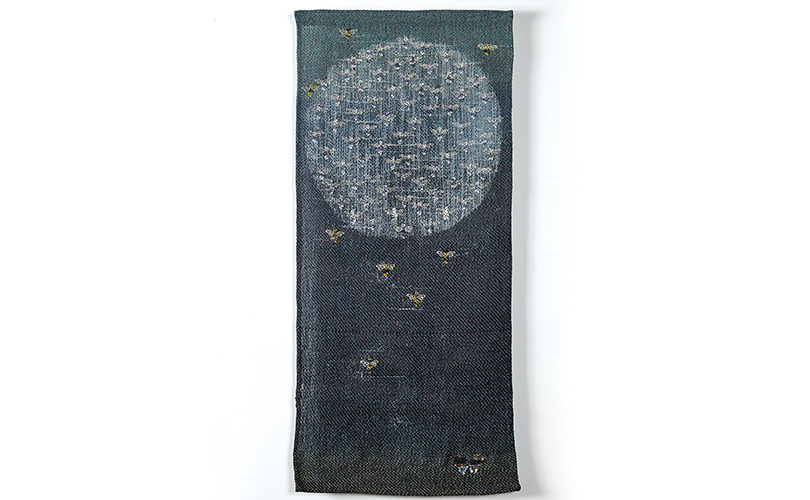
18lf Being Here, Laura Foster Nicholson, wool with metallic, 41” x 34”, 2011. Photo by Tom Grotta

Another work that connects with Nature is Laura Foster Nicholson’s Being HereBees are a metaphor for the soul, Nicholson says. Her work Being Here, is from a series of works involving bees and bee hives. Nicholson often reflects gardens and scenes of domesticity in her tapestries. “I have been a beekeeper, and always felt that it was magical and a true privilege to don a bee suit and stand among thousands of busy, humming honeybees. Being Here is the culmination of a body of work about moving through pain to the state of grace that is acceptance.  The orb of shimmering insects represents the final opening up to the transformation.”

Yeonsoon Chang dimensional grid
18yc Matrix III-201612, Yeonsoon Chang, polyester mesh, machine sewn, 14” x 14” x 4.75”, 2017. Photo by Tom Grotta

Yeonsoon Chang has created an eco-friendly resin to use in creating sculptural works of hemp and polyester mesh. Recurring themes in Chang’s work include time, space, and the myriad relationships that intertwine them. Chang’s process requires 12 complex and meticulous steps, including refining, dying, ironing, and sewing, all of which require considerable mental focus. She considers it her calling to bring to life the spirit of Korean craft, allowing it to breathe and resonate through works like Matrix III-201612. Chang was a Loewe Foundation Prize nominee and the first Korean artist to have her works acquired by the renowned Victoria & Albert Museum in the UK. Her work was also featured in the Cheongju Craft Biennale in 2025.

Small Dorothy Gill Barnes Pine Bark Basket
91dgb Inside-Outside, Dorothy Gill Barnes, woven pine bark, 3.5” x 3” x 3.5”, 1990’s. Photo by Tom Grotta

Inside-Outside by Dorothy Gill Barnes is an excellent illustration of the artist’s remarkable way with wood (the name of browngrotta arts’ 2023 monograph, Dorothy Gill Barnes: A Way with Wood, in fact).  Bark—from pine, spruce, elm, basswood, mulberry, and many other trees—played a seminal role in her work. She cut or tore bark in strips and wove it into basket- or vessel-like forms, folded it into rectangular boxes and windows, pulled it back like a banana peel, and wrapped it around rocks. To add tension and contrast, she paired bark from different species of trees, different textures of bark from the same tree, and peeled or unpeeled surfaces. In Inside-Outside, she has paired wood strips with bark and strips without bark, weaving them to form the base and stitching the strips to form the sides.  

More works to come in February!